
Tire tread or belt separation in defective Firestone tires has directly caused hundreds of motor vehicle accidents resulting in death or serious injury.
Study of Firestone Tires
The National Highway Traffic Safety Administration tasked their Office of Defects Investigation, or ODI for short, with expanding their investigation of defective tires. The focus of the their research was on non-recalled tires with similarities to the recalled Firestone tires (such as Wilderness AT tires of the size P235/75R15 and P255/70R16 manufactured by Firestone for the Ford Motor Company as original equipment), as well as replacement tires manufactured to the same specifications (“focus tires”).
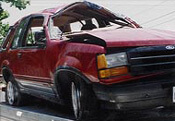
Most of the focus tires were manufactured at Firestone’s Wilson, North Carolina and Joliette, Quebec, Canada plants, beginning in 1994. In late 1998, Firestone began producing P255/70R16 Wilderness AT tires at its Decatur, Illinois facility, and in mid-1999, it started making P235/75R15 Wilderness AT tires at a new plant in Aiken, South Carolina. Approximately 100,000 P235/75R15 Wilderness AT tires were produced at Firestone’s Oklahoma City, Oklahoma plant. The focus tires were predominantly used as original equipment on Ford Explorer SUVs and, to a lesser extent, on Ford Ranger compact pickup trucks, and as replacement tires for use on these and other SUVs and pickups.
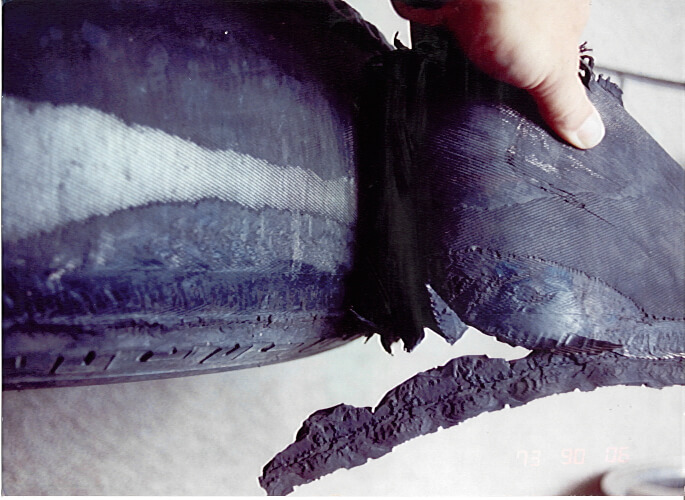
The belt-leaving-belt tread separations that have occurred in the recalled and focus tires began as belt edge separation at the edge of the second, or top, belt. This is the area of highest strain in a steel belted radial tire, and it is also has relatively poor cord-to-rubber adhesion thanks to bare steel at the cut ends of the cords. Once belt-edge separations start, they can grow circumferentially and laterally along the edge of the second belt and develop into cracks between the belts. If they get large enough, they can result in catastrophic tread detachment, particularly at high speeds when the centrifugal forces acting on the tire are at their greatest.
Non-destructive analysis tests were performed on numerous randomly collected focus tires and peer tires from the southern states, where most of the tire failures have occurred. The non-destructive analysis tests use shearography, which can detect separations inside a tire. Shearography analysis tests demonstrated that the patterns and levels of cracks and separations between the belts were far more severe in the focus tires than in the peer tires. Many of the focus tires examined were in the later stages of failure progression prior to complete separation of the upper belt.
A critical design feature used by tire manufacturers to suppress the initiation and growth of belt-edge cracks is the “belt wedge,” a strip of rubber located between the two belts near the belt edges on each side of the tire. The belt wedge thickness, or gauge, in the Firestone ATX tires and the Wilderness AT tires produced prior to May 1998 is generally narrower than the wedge gauge in peer tires, and the wedge gauge in cured tires was often less than Firestone’s target for this dimension. The Firestone tires with this narrow wedge did not adequately resist the initiation and propagation of belt-edge cracks between the steel belts. During March and April of 1998, Firestone changed the material composition and increased the gauge of the wedge in its Wilderness AT tires and some additional models. Another important feature of radial tires related to the prevention of belt-leaving-belt separations is the gauge of the rubber between the two steel belts, or “inter-belt gauge.” The inter-belt gauge initially specified by Firestone for the focus tires is generally narrower than the inter-belt gauges in peer tires, and is narrower than Firestone’s original specification for the ATX tires from the early 1990s. Moreover, the actual measured gauge under the tread grooves in several of the focus tires measured by ODI was far less than Firestone’s minimum design specification. Since an inadequate inter-belt gauge reduces the tire’s resistance to crack growth and its belt adhesion capabilities, this narrow inter-belt gauge may be partially responsible for the relatively low peel adhesion properties of the focus tires compared to peer tires. In August 1999, after becoming concerned about the adequacy of the inter-belt gauge in the cured Wilderness AT tires, especially in the regions directly under the tread grooves, Firestone changed the inter-belt gauge specification back to the original dimensions. Another relevant feature is the design of the focus tires’ shoulder pockets. The shoulder pocket design caused higher stresses at the belt edge and lead to a narrowing, or “pinching,” of the wedge gauge at the pocket. The focus tires exhibit a series of weak spots around the tire’s circumference, leading to the initiation and growth of cracks earlier than in competitor tires and in other Firestone tires produced for light trucks and SUVs. In addition, many of the focus tires exhibited shoulder pocket cracking similar to that which Firestone identified as a significant contributor to the risk of tread detachment in the recalled ATX tires.
Because the tread separations at the center of this investigation occur only after several years of exposure, almost all of the tire failures on which the Office of Defects Investigation analysis of field experience was based involved tires manufactured before May 1998, when Firestone increased the dimensions and improved the material of the belt wedge. In theory, these modifications to the wedge would tend to inhibit the initiation and propagation of the belt-edge cracks that lead to tread separations. If these modifications actually improved the resistance of the focus tires to belt-edge separations, the historical failure trends described above may not predict the future performance of the newer tires.
On the basis of the information developed during the ODI investigation, NHTSA made an initial decision that a safety-related defect exists in Firestone Wilderness AT P235/75R15 and P255/70R16 tires manufactured to the Ford specifications prior to May 1998 that were installed on SUVs. These tires were manufactured primarily at the Wilson and Joliette plants and, to a lesser extent, at Oklahoma City. The initial decision did not apply to the P255/70R16 tires produced at Decatur or any of the Wilderness AT tires produced at Aiken, since these tires were all manufactured after May 1998.
Serious Accident and Injury Legal Help with Firestone Tire Defects
Willis Law Firm earned the 2001 Steven J. Sharp Award for its leadership in recalling the thousands of Firestone tires responsible for serious injury and death. We are here to serve individuals and families impacted by tire defect accidents, such as roof crushes, rollovers, tread separations and blowouts, with services that include evidence gathering and investigations in addition to litigation. Please call us toll-free at 1-800-883-9858 or send us an email to schedule your consultation today.